
In custom furniture, a quotation depends on much more than price. Measurements, technical constraints, customer preferences and production requirements all need to be captured and translated into a workable solution.
For this Belgian company specialising in custom-made kitchens, wardrobes and interior furniture, the objective was to structure that information in Odoo and use technology to reduce repetitive work around it.
FROM THE SITE VISIT TO STRUCTURED DATA
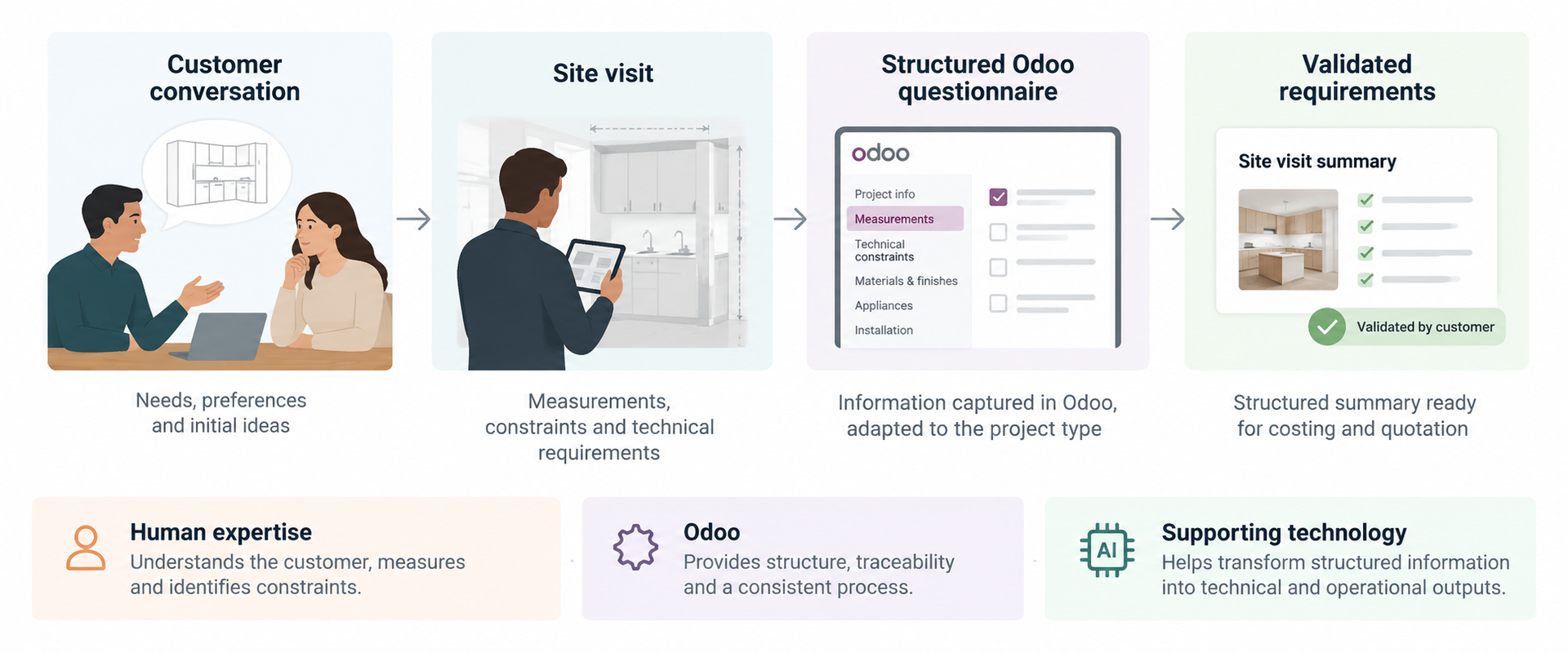
The commercial process starts in Odoo CRM, where the customer, project type, source and next steps are managed through a defined pipeline.
The critical step comes during the site visit.
The advisor records measurements, room constraints, materials, finishes, access conditions and customer requirements directly against the opportunity. The questionnaire adapts to the project type and can include specific questions for kitchens, wardrobes or other custom furniture projects.
This remains a human task.
The system provides structure and traceability, but the advisor still needs to understand what the customer wants and recognise technical constraints that require judgement.
At the end of the visit, Odoo generates a structured summary that can be validated by the customer before quotation preparation begins.
REUSING INFORMATION INSTEAD OF ENTERING IT AGAIN
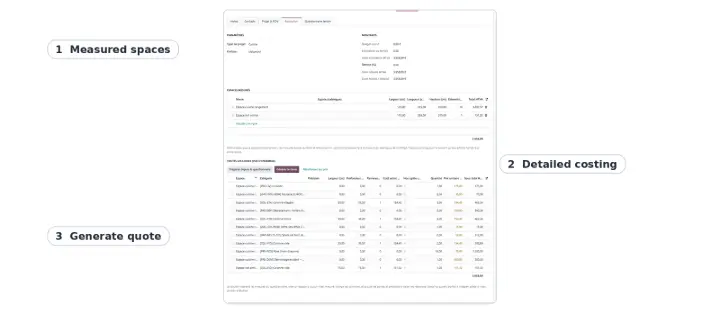
Once the visit is completed, the same information is reused for costing.
Measurements and questionnaire answers feed the estimation process, where spaces, columns, doors, accessories and services can be prepared and adjusted before pricing.
The important principle is simple: The system prepares. The user validates.
This reduces the need to reinterpret notes or enter the same information several times while keeping the final decision with the person responsible for the project.
WHERE THE INTELLIGENT LAYER FITS
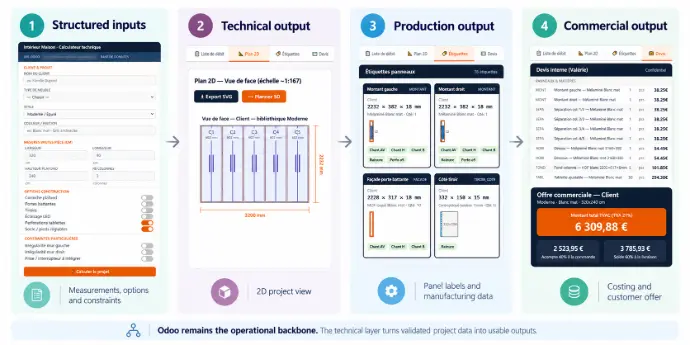
The project also connects Odoo with a dedicated technical application.
Project information can be loaded from the Odoo opportunity into this tool, including room measurements, type of furniture, finishes, options and technical constraints.
The application then produces several outputs required further downstream:
- cutting lists with dimensions and materials
- 2D project views
- workshop labels
- internal and commercial costing information
- production data that can be exported to the workshop software
The result is then pushed back into Odoo.
This is where the combination becomes valuable.
The technology is not operating in isolation. It works with information that already belongs to a customer, an opportunity and a structured business process.
BACK INTO ODOO
Once the project has been reviewed and priced, Odoo generates the commercial quotation from the information already structured throughout the process.
The proposal can automatically include each space, dimensions, composition, accessories, materials, finishes and installation services.
The customer then reviews and accepts the quotation through the Odoo portal, converting it into a sales order and completing the commercial flow.
The value is not the final PDF.
It is the continuity of information behind it.
HUMAN EXPERTISE, ODOO AND AI IN THE SAME FLOW
The process can be summarised simply:
Lead → Site visit → Structured requirements → Costing → Technical calculation → Human review → Odoo quotation → Production preparation
Each layer has a different role.
Human expertise interprets the customer, identifies constraints and validates the solution.
Odoo provides the operational backbone, workflow, data structure and traceability.
AI and supporting technology help transform structured information into technical and operational outputs.
OXALYO'S TAKE
AI becomes useful when it has a good process around it.
The objective should not be to insert AI into an existing workflow simply because the technology is available.
The first questions should still be operational ones.
What information needs to be captured? Where is judgement required? What can be reused? What needs to be validated? What does the next person in the process need?
In this project, human expertise remains where context and technical judgement matter. Odoo provides the structure. Technology helps process the information around those decisions.
That is how we see AI contributing to ERP projects: as part of the flow, not as a separate destination.
Discover how to unlock your company's full growth potential